

New Accountability Era: The Bangladesh Travel Agency Ordinance 2026 Explained

An In-Depth Look at the Bangladesh Travel Agency Ordinance 2026 (Registration, Regulation and the Amendment)
This year, Bangladesh introduced one of its most far-reaching reforms for the travel industry through the Bangladesh Travel Agency Ordinance 2026. This move prompted immediate debate across the sector as agencies began assessing what the new requirements mean for their daily and overarching operations. The Bangladesh Travel Agency Ordinance 2026, promulgated by the President on 1 January under Article 93(1) of the Constitution while Parliament was dissolved, amends the 2013 Act with sweeping new definitions, obligations, and enforcement powers.
According to the Gazette, the Government has justified the measure on grounds of urgent necessity, citing repeated complaints over unfair ticket pricing, improper sales practices, misuse of digital ticketing systems, and harassment of passengers, particularly migrant workers. The Bangladesh Travel Agency Ordinance 2026 claims to strengthen customer protection and improve governance across both offline and online travel agency operations.
One of the most significant changes appears in the complete substitution of Section 2 of the 2013 Act. The Amendment introduces several new legal definitions, detailing the meaning of advance payments, beneficial ownership, family member involvement in the business, business-to-business transactions, arms-length dealings, and what constitutes a false booking. By giving formal recognition to practices that were previously unregulated or ambiguously interpreted, the Government has created a structured basis for enforcement.
For example, the definition of “false booking” in the Bangladesh Travel Agency Ordinance 2026 targets the blocking of airline seats using incorrect or fictitious information to create artificial scarcity. The inclusion of this definition is likely to attract particular scrutiny from regulators and market participants, as it is widely regarded as one of the principal factors contributing to sudden and artificial increases in ticket prices.
The Bangladesh Travel Agency Ordinance 2026 also inserts a new Section 2A, declaring that the Act will prevail over any conflicting law in matters relating to registration, control, and operation of travel agencies. This overriding clause signals that the Government intends for the amended law to act as the controlling framework for the industry.
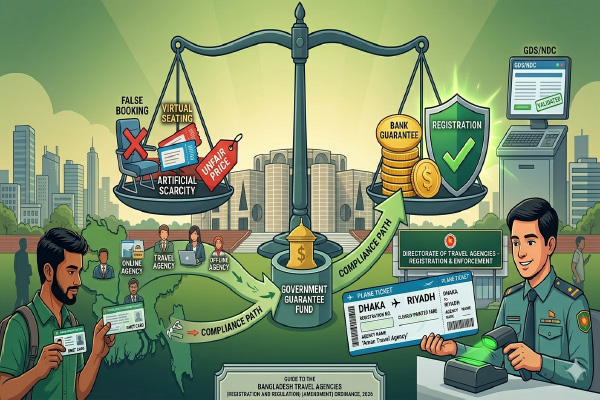

Registration requirements have also been significantly tightened. Under the Act’s newly revised Section 5, agencies must now submit an affidavit affirming that no excess money will be charged, no false inducement will be used, and no tickets will be purchased or sold from any other travel agency. They must also confirm that no recruiting activities will be carried out from the travel agency address. Additionally, agencies will need to disclose detailed information if any family member operates a separate agency. Required information includes: registration numbers, national identification documents, passport details, photographs, inheritance documentation (where relevant), sources of funds, ultimate beneficial ownership, and bank account information.
The Bangladesh Travel Agency Ordinance 2026 further introduces substantial financial obligations. Offline agencies must submit a bank guarantee of BDT ten lakhs, while online platforms must provide a guarantee of BDT one crore. Sector analysts say this requirement alone could reshape the competitive landscape, placing pressure on smaller operators who lack the capital reserves to meet the guarantee threshold.
The amendments to Sections 6, 7 and 9 collectively expand the grounds on which an agency’s license may be suspended, cancelled, or denied renewal. Moving forward, no loan defaulter shall be considered eligible to obtain a registration certificate. The law now prohibits purchasing or selling tickets from another agency; charging additional fares; operating recruiting activities from the same premises; conducting transactions outside government-approved channels; inflating prices through artificial crises or false bookings; and issuing misleading promotional offers involving cashback or incentives. Additional restrictions apply to ticketing for migrant workers and BMET cardholders, including third-country ticketing, group booking changes, and consolidated payments.
Use of airline or GDS/NDC employees within an agency’s activities is prohibited. Agencies must also ensure that their name, registration number, and ticket price are clearly printed on the ticket.
A notable change is the Government’s new authority to temporarily suspend a registration certificate without holding a prior hearing. Officials have justified that this measure is necessary in order to act swiftly in service of the public interest, particularly in situations involving fraud, market manipulation, or immediate consumer risk. However, some stakeholders fear that such discretionary power may cause uncertainty if exercised without procedural safeguards.
The penalties introduced under the revised Section 11 mark a stronger enforcement posture. Any violation of the Act or its rules now constitutes a criminal offence punishable by up to one year of imprisonment, a fine of up to BDT ten lakhs, or both. The Bangladesh Travel Agency Ordinance 2026 also introduces a new travel ban provision in Section 11C, allowing authorities to prevent the sudden departure of individuals linked to fraudulent or corrupt activities via coordination with the Ministry of Home Affairs. Section 11D authorizes the Government to issue binding directions to regulatory authorities to ensure uniform enforcement.
The Bangladesh Travel Agency Ordinance 2026 also reshapes the existing reporting framework. Now, agencies must file an annual activity report and financial report with the Government. Agencies will only be considered eligible for renewal of their registration if said report is deemed satisfactory. Report submission will be required every three years.
Thus far, reactions within the industry have been mixed. Some agency owners see the reforms as necessary to curb irregularities that have plagued the sector for years, including systemic misuse of digital distribution systems, opaque ownership structures, and the exploitation of passengers. Others argue that the combined effect of the new financial guarantees, compliance disclosures, and activity restrictions may threaten the viability of many small and medium-sized agencies that tend to lack access to large capital pools or direct airline accreditation. The prohibition on purchasing tickets from other agencies is considered particularly challenging, as only a limited number of operators hold IATA accreditation and most rely on inter-agency arrangements to serve customers.
Government officials maintain that the Bangladesh Travel Agency Ordinance 2026 is intended to bring accountability and transparency to a sector that has grown rapidly without adequate oversight. As such, the prescribed reforms have been described as essential for protecting consumers, safeguarding migrant workers, improving the integrity of digital ticketing systems, and ensuring fair market conduct.
As the industry absorbs and begins to enact these changes, discussions are expected to continue between travel agency associations, aviation regulators, and Government bodies to navigate implementation challenges. The full impact of the Bangladesh Travel Agency Ordinance 2026 will become clearer in the months ahead as agencies begin adjusting their operations to comply with the new legal and regulatory framework.
References:
- New ordinance sparks concern among travel agencies, The Business Standard, Jan 2026 —
https://www.tbsnews.net/bangladesh/new-ordinance-sparks-concern-among-travel-agencies-1325976 (The Business Standard) - New ordinance could shut down 5,000 agencies: Travel sector leaders, The Daily Star, Jan 2026 —
https://www.thedailystar.net/life-living/travel/news/new-ordinance-could-shut-down-5000-agencies-travel-sector-leaders-4073406 (The Daily Star) - Ordinance toughens penalties for travel agency violations, The Financial Express / BSS, Jan 2026 —
https://thefinancialexpress.com.bd/national/ordinance-toughens-penalties-for-travel-agency-violations (The Financial Express) - New government decision for online travel agencies, Bangladesh Monitor, Jan 2026 —
https://www.bangladeshmonitor.com.bd/lead-news-details/new-government-decision-for-online-travel-agencies (The Bangladesh Monitor) - Travel agencies must display fares on tickets, The Business Standard, Nov 2025 —
https://www.tbsnews.net/economy/travel-agencies-must-display-fares-tickets-non-compliance-face-legal-action-adviser-bashir (The Business Standard) - Travel agencies demand repeal of new ordinance, New Age, Nov 2025 –
https://www.newagebd.net/post/mis/283060/travel-agencies-demand-repeal-of-new-ordinance (New Age)
Share this Article