

Protection of Minority Shareholders Under Companies Act 1994

Protection of Minority Shareholders Under Companies Act, 1994 — How Section 233 Safeguards Minority Interests Against Oppression and Mismanagement in Bangladesh
A company is a separate legal entity, but its affairs are ultimately conducted for the benefit of its shareholders. Because shareholders invest capital and collectively own the company, company law protects their rights through corporate-governance principles and legal remedies. One important safeguard is the remedy for unfair prejudice and mismanagement, which protects shareholders when majority conduct adversely affects their interests.
In Bangladesh, these safeguards are found in several provisions of the Companies Act, 1994. Section 233 is the principal statutory remedy for oppression and mismanagement because it allows the court to intervene when a company’s affairs are conducted in a manner prejudicial to minority shareholders or detrimental to the company’s interests.
Who Are Minority Shareholders?
Minority shareholders are shareholders who do not hold a controlling interest in a company. In practical terms, they usually hold less than 50–51% of the voting shares and therefore cannot, on their own, determine resolutions or control the composition of the board. Although the Companies Act, 1994, does not expressly define “minority shareholder,” a person seeking statutory protection under Section 233 must satisfy the eligibility requirements in Section 195.
What Does the Statute Say?
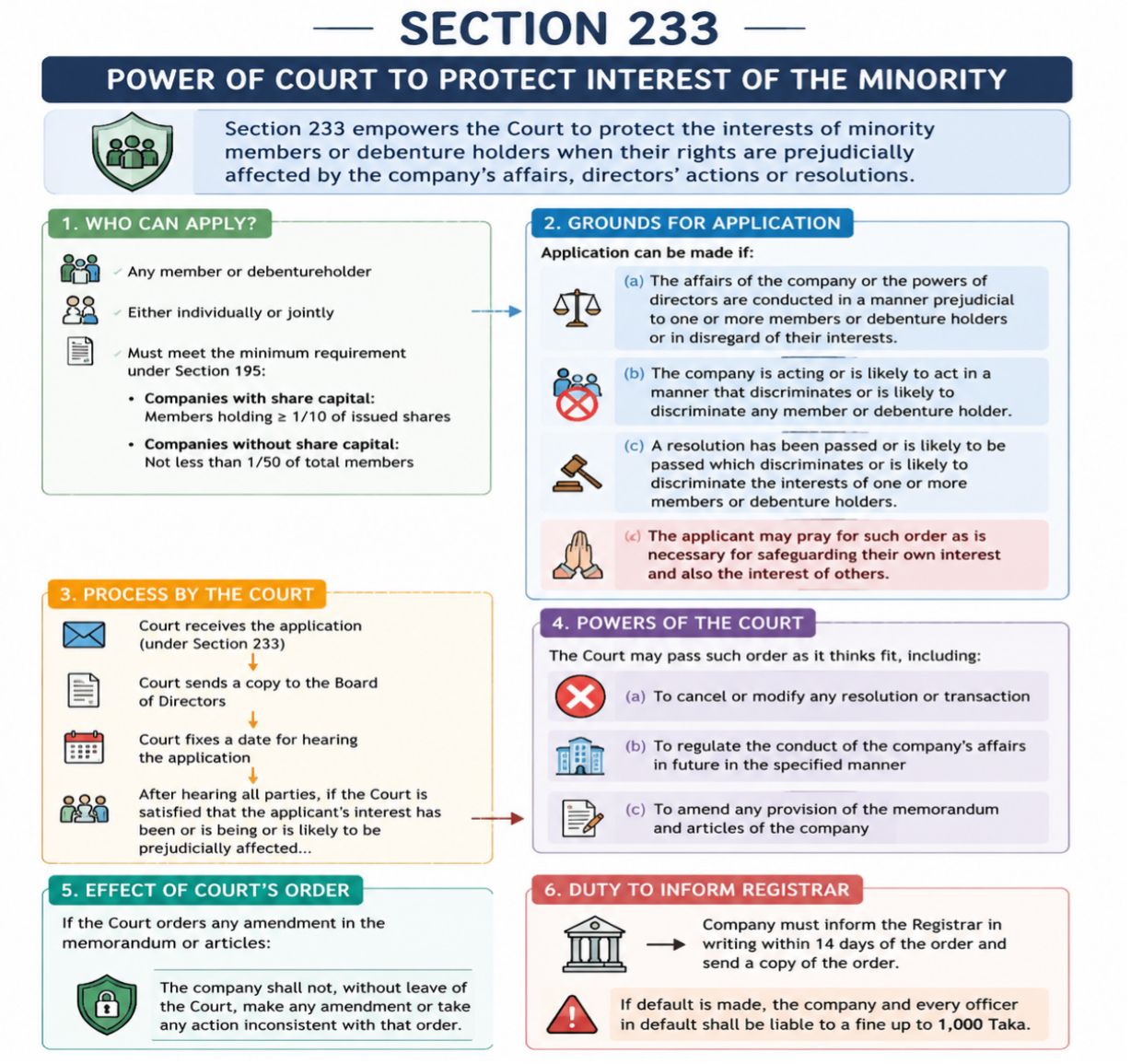
Section 233 is expressly titled “Power of Court to Give Direction for Protecting Interest of the Minority” and sets out three trigger situations:
- Company affairs are conducted, or directors’ powers are exercised, in a manner prejudicial to one or more members or debenture holders or in disregard of their interests.
- The company acts, or is likely to act, in a way that discriminates or is likely to discriminate against the interests of any member or debenture holder.
- A resolution has been passed, or is likely to be passed, which discriminates or is likely to discriminate against the interests of one or more members or debenture holders.
Who Can Apply?
Any member or debenture holder may individually or jointly apply to the Court under this section, provided the ownership thresholds in Section 195 are met:
- At least one-tenth of issued shares in companies with share capital, or
- One-fifth of members in companies without share capital.
These conditions ensure that only a genuine minority shareholder, with a real stake in the company, can invoke the remedy.
Scope of the Court’s Powers
Once the Court is satisfied that the applicant’s interests have been, are being, or are likely to be prejudicially affected for one of the reasons specified, Section 233 authorizes it to make “such order as prayed for or such other order as it deems fit” for safeguarding the interests at stake.
The statute provides a non-exhaustive list of three types of directions:
- Cancelling or modifying any resolution or transaction.
- Regulating the conduct of the company’s affairs in future in a specified manner.
- Amending any provision of the memorandum or articles of the company, with the added safeguard that the company cannot later amend or act inconsistently with those amendments without leave of the Court.
In M.A. Gaffur v. Registrar of Joint Stock Companies, the High Court Division described the jurisdiction under Section 233 as “regulatory and preventive in nature” and stressed that the Court may pass “any order or orders” necessary to protect minority shareholders and prevent mismanagement.
This judgment shows that beyond the listed powers, the Court can tailor remedies to the facts of each case, including reconstituting boards, ordering audits, or directing specific governance reforms.
Judicial Precedents Demonstrating the Court’s Power to Safeguard Minority Shareholders
Bangladeshi courts have consistently interpreted Section 233 of the Companies Act, 1994 as a safeguard against oppression and mismanagement. The following judicial decisions demonstrate how the courts have protected minority shareholders while ensuring that companies are managed fairly.
- Protection against majority oppression: In Nafisa Chowdhury v. United Food Complex Ltd. (53 DLR (2001) HCD 81), the High Court Division recognized that majority shareholders cannot use their voting power to act unfairly towards minority shareholders. The Court held that it may intervene whenever internal corporate mechanisms fail to prevent prejudice.
- Power to grant appropriate remedies: In Nahar Shipping Lines Ltd. v. Homera Ahmed (56 DLR (AD) 36, 2004), the Appellate Division clarified that the Court is not restricted to granting only the relief specifically requested by the petitioner. Instead, it may pass any order necessary to remove the effects of oppressive conduct and restore fairness in the company’s affairs.
- Preventing mismanagement: In M.A. Gaffur v. Registrar of Joint Stock & Others (4 LNJ 661, 2015), the Court explained that Section 233 is intended not only to remedy existing prejudice but also to prevent mismanagement. It affirmed that the Court has broad powers to regulate the affairs of a company whenever necessary to protect minority shareholders.
- Persons eligible for protection: In Moksudur Rahman v. Bashati Property Development Ltd. (49 DLR 539, 1997), the High Court Division clarified that Section 233 is available only to shareholders who satisfy the statutory requirements and whose rights as shareholders have been affected. The provision is therefore aimed at addressing shareholder oppression rather than ordinary management disagreements.
- Wide judicial discretion: In Abu Taher v. Nur Mohammad & Others, the Court reaffirmed that it may issue any order necessary to safeguard minority shareholders and restore the company’s affairs to proper governance, even where the exact relief sought is insufficient to resolve the injustice.
These decisions collectively demonstrate that Section 233 empowers the courts to intervene where majority power is abused, to prevent corporate mismanagement, and to ensure that minority shareholders receive effective protection.
The Scope and Limits of the Court’s Powers under Section 233
The Court’s powers under Section 233 are wide in at least four dimensions:
- Substantive Reach: The Court may intervene where there is prejudice, discrimination, or likely oppression, even if the impugned acts are technically legal under the Articles or the Act.
- Remedial Flexibility: It can cancel or modify resolutions and transactions, regulate future conduct, amend constitutional documents, restructure boards, order audits, and impose reporting obligations, and is not confined to the relief expressly prayed for.
- Preventive Orientation: Relief can be granted not only after harm has occurred, but where resolutions or conduct are “likely” to be discriminatory or prejudicial, allowing the Court to act before damage becomes irreversible.
- Continuing Supervision: By making amendments that cannot be reversed without leave, and by issuing governance directions, the Court assumes an ongoing supervisory role akin to a “corporate ombudsman.”
At the same time, this power is not unlimited. The main limits are:
- Jurisdictional Thresholds: Applicants must meet the Section 195 thresholds and be members or debenture holders; majority shareholders or outsiders cannot use Section 233 as a generic dispute forum.
- Nature of the Grievance: The conduct must affect rights as investors; purely personal or employment disputes, such as loss of managerial office, are generally outside the section unless connected to oppression of minority shareholders.
- Just and Equitable Standard: Remedies must be just and equitable; Courts favor proportionate measures that restore fairness and corporate health over extreme steps like winding up or permanent judicial management.
- Respect for Internal Management: The traditional doctrine of non-intervention continues to apply in the background, so Courts do not simply substitute their commercial judgment for that of directors on ordinary business decisions.
Thus, Section 233 establishes a broad, equitable jurisdiction allowing the Company Court to act as a guardian of minority interests and corporate fairness, while remaining anchored in clear thresholds and principled limits. From a client’s perspective, it offers a powerful mechanism to correct and prevent abuse of majority power without dismantling the company itself.
International Perspectives: Minority Shareholder Protection in the United Kingdom and India
United Kingdom
The UK has a well-developed system under the Companies Act 2006. The main protection is the unfair prejudice remedy (section 994). A shareholder can ask the court for help if the company’s affairs are run in a way that is unfairly harmful to their interests.
A leading case is Ebrahimi v. Westbourne Galleries Ltd [1973] AC 360. In this decision, the House of Lords recognized that, in small companies based on personal trust, often called “quasi-partnerships,” majority shareholders must act fairly. Even actions that are legally correct can be unfair if they violate the understood expectations between shareholders, such as the right to participate in management. The court can order remedies, including a buy-out of shares at fair value. UK law focuses on fairness and the protection of reasonable expectations in private companies.
India
India provides protection under the Companies Act 2013. Sections 241–242 allow shareholders to apply to the National Company Law Tribunal (NCLT) in cases of oppression or mismanagement.
The Tribunal has broad powers to issue orders that regulate the company’s affairs, cancel resolutions, or require a buy-out of shares. Indian courts look at whether majority actions are unfair or harmful to the company or minority shareholders. They often consider the overall fairness and legitimate expectations of the parties.
Conclusion
Section 233 of the Companies Act, 1994 is a powerful and flexible tool that enables the courts in Bangladesh to protect minority shareholders from unfair treatment and mismanagement. It strikes a careful balance between majority rule and minority rights, while promoting good corporate governance. Together with judicial precedents and international benchmarks from the UK and India, it forms part of a growing framework that supports fair and transparent business practices in Bangladesh.
Disclaimer: This document is for general information and educational purposes only. It does not constitute legal advice. Laws may change, and outcomes depend on specific facts. Readers are advised to seek independent professional legal advice from a qualified lawyer. Our team is available to provide tailored assistance on minority shareholder protection and corporate matters.
References:
Legislation
- Companies Act, 1994 (Bangladesh) Available at: <https://basis.org.bd/public/files/policy/5e1654acafde5companiesact_0.pdf> accessed 9 July 2026.
- Companies Act 2006 (UK), s 994
- Companies Act 2013 (India), ss 241–242
Cases
- Abu Taher v Nur Muhammad (Appellate Division, 7 January 2001)
- HBS Association (Pvt) Ltd v Professor Shahabuddin Khaled Chowdhury (Appellate Division, 22 February 2005)
- M A Gaffur v Registrar of Joint Stock Companies and Others (2015) 4 LNJ 661
- Moksudur Rahman v Bashati Property Development Ltd (1997) 49 DLR (HC) 539
- Nafisa Choudhury v United Food Complex Ltd (2001) 53 DLR (HC) 81
- Nahar Shipping Lines Ltd v Homera Ahmed (2004) 56 DLR (AD) 36
- Ebrahimi v. Westbourne Galleries Ltd [1973] AC 360 (House of Lords.
Secondary Sources
- ‘Relief and Prevention of Mismanagement’ (LawTeacher.net, 30 June 2025) <https://www.lawteacher.net/free-law-essays/business-law/relief-and-prevention-of-mismanagement-business-law-essay.php> accessed 9 July 2026.
- ‘Oppression and Mismanagement under Company Law’ (The Legal 500 Thought Leadership, 30 December 2025) <https://www.legal500.com/developments/thought-leadership/oppression-and-mismanagement-under-company-law/> accessed 9 July 2026.
- ‘Protection of Minority Shareholders’ (The Daily Star, Dhaka, 2023) <https://www.thedailystar.net/law-our-rights/news/protection-minority-shareholders-3386151> accessed 9 July 2026.
- Niladri Mondal, ‘The Evolving Role of Minority Shareholders in Corporate Decision Making: Navigating the Tensions Between Unsettling Concerns and Reassuring Outcomes’ (2016) 9(1) NUJS Law Review <https://www.nujs.edu/wp-content/uploads/2024/04/Volume-9-Issue-1-7.pdf> accessed 9 July 2026.
Share this Article
Find Here More Articles